


Next: Results and Discussions
Up: Problem Formulation
Previous: Problem Formulation
Affine Homography
We first look at the case when the transformation between
two views is affine. The third row of the matrix  in Equation 1, has the special form
![$[0\,\, 0 \,\,1]$](img16.png) for affine transformations. We can write
Equation 1 in this case as
for affine transformations. We can write
Equation 1 in this case as
where A is a  matrix,
  is a translation vector
and
is a translation vector
and  is the view index, with
  being considered to be the
reference view. We can discard the effect of vector by
discarding the DC component - the Fourier coefficient
corresponding to
being considered to be the
reference view. We can discard the effect of vector by
discarding the DC component - the Fourier coefficient
corresponding to  (or by shifting the origin to the
centroid of the shape). The affine transformation can now be
written as
(or by shifting the origin to the
centroid of the shape). The affine transformation can now be
written as
without any loss in generality.
In general, correspondence between images, i.e., information
as to which image points in different views are projections
of the same 3D point, is not available. This implies that
when the boundary is seen in two views, the description may
not start from the same point. In other words, there is an
unknown shift between the sequences of boundary points in
different views. This shift in the spatial domain translates
into a rotation in the Fourier domain. Equation 3
can now be written as
![\begin{displaymath}
{\bf\bar{X}}^l[k] = {\bf A} {\bf\bar{X}}^0[k]\,
e^{\omega_k\lambda_l}
\end{displaymath}](img27.png) |
(4) |
where,  is the unknown shift in view ,
  is the number of points on the boundary of the shape, and
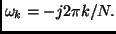 Let us define a measure called the cross-conjugate
product (CCP) on the Fourier representations of two views
as
Let us define a measure called the cross-conjugate
product (CCP) on the Fourier representations of two views
as
The matrix  can be expressed as a sum
of a symmetric matrix and a skew symmetric matrix as
can be expressed as a sum
of a symmetric matrix and a skew symmetric matrix as
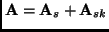 where
where
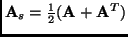 and
and
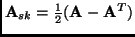 . The skew symmetric matrix
reduces to
. The skew symmetric matrix
reduces to
where
 is the difference of the
off-diagonal elements of . We now have
is the difference of the
off-diagonal elements of . We now have
The term
![${\bf\bar{X}}^0[k]^{*T} {\bf A}_s {\bf\bar{X}}^0[k]$](img42.png) of the
above equation is purely real and the term
of the
above equation is purely real and the term
![${\bf
\bar{X}}^0[k]^{*T} c\left[ \begin{array}{cr} 0 & 1 \\ -1\;\; & 0
\end{array} \right] {\bf\bar{X}}^0[k]$](img43.png) is purely
imaginary. The phases of
is purely
imaginary. The phases of  and
and  depend
only on the shift . Thus, can be
recovered from the inverse Fourier transform of
or , if known. However, we can only compute
depend
only on the shift . Thus, can be
recovered from the inverse Fourier transform of
or , if known. However, we can only compute
 , a combination of and ,
which is not directly useful to recover the shift.
We observe that the effect of the transformation matrix
, a combination of and ,
which is not directly useful to recover the shift.
We observe that the effect of the transformation matrix  on is restricted to a scaling by a factor
  . We
can define a new measure
. We
can define a new measure  , ignoring scale, for the
sequence
, ignoring scale, for the
sequence
 as
as
![\begin{displaymath}
\kappa(l) = {\bf\bar{X}}^l[k]^{*T} \left[ \begin{array}{cr} 0 & 1 \\
-1\;\; & 0 \end{array} \right] {\bf\bar{X}}^l[k].
\end{displaymath}](img49.png) |
(7) |
It can be shown that
Equation 8 gives a necessary condition for the
sequences
and
 to be two
different views of the same planar shape, or in other words, the
values of the measure
to be two
different views of the same planar shape, or in other words, the
values of the measure  in the two views
should be scaled versions of each other. This extends to
multiple views also. We can express it differently in
multiple views. Consider the
in the two views
should be scaled versions of each other. This extends to
multiple views also. We can express it differently in
multiple views. Consider the
 matrix formed by the coefficients
of the measures for M different views.
matrix formed by the coefficients
of the measures for M different views.
The necessary condition for matching of the planar shape
in views then reduces to
 |
(9) |
It should be noted that this recognition condition does not
require correspondence between views and is valid for any
number of views.
Can we also estimate the shift that would align
corresponding points in two views? The answer is yes, using
a measure  for a fixed
  given by
![\begin{displaymath}
\kappa_{mod}(l, p) = (X^l[k])^{*T} \left[ \begin{array}{cl} 0 &
1 \\ -1\;\; & 0 \end{array} \right] X^l[p]
\end{displaymath}](img60.png) |
(10) |
correlates each Fourier descriptor coefficient
with a fixed one within each view. Following a chain of reasoning
similar to the one above,
we can show that
Equation 11 states that the phases of
 and
and
 differ by a value
proportional to the shift and the differential
frequency
differ by a value
proportional to the shift and the differential
frequency  . Therefore, the ratio
 will be a complex sinusoid. The value
of can be computed from the inverse Fourier
transform of the quotient series. Thus, we can compute the
correspondence between points on the shape boundary across views by
determining
as above, starting with no prior knowledge.
The measure can also be adopted for the purpose
of recognition. However, this approach would not be
discussed in this paper for want of space.
The general projective homography relating two different views of the same planar shape
can be reasonably approximated by an affine homography.
This approximation seems to be a practical one as most real life configurations of imaging a
scene from multiple view points, possess structure
that are very close that of affine homographies. This assumption is also validated by the
results for general homographies, which are presented in the next section.
will be a complex sinusoid. The value
of can be computed from the inverse Fourier
transform of the quotient series. Thus, we can compute the
correspondence between points on the shape boundary across views by
determining
as above, starting with no prior knowledge.
The measure can also be adopted for the purpose
of recognition. However, this approach would not be
discussed in this paper for want of space.
The general projective homography relating two different views of the same planar shape
can be reasonably approximated by an affine homography.
This approximation seems to be a practical one as most real life configurations of imaging a
scene from multiple view points, possess structure
that are very close that of affine homographies. This assumption is also validated by the
results for general homographies, which are presented in the next section.
Next: Results and Discussions
Up: Problem Formulation
Previous: Problem Formulation
2002-10-09
![\begin{displaymath}{\bf x}^l[i] = {\bf A} {\bf x}^0[i] + {\bf b} \end{displaymath}](img17.png)
![\begin{displaymath}c \left[ \begin{array}{cr} 0 & 1 \\ -1\;\; & 0 \end{array} \right], \end{displaymath}](img38.png)
![\begin{displaymath}\Theta =
\left[ \begin{array}{ccc}
\kappa(0)[1] & \cdots ...
...ppa(M-1)[1] & \cdots & \kappa(M-1)[N-1]
\end{array} \right]
\end{displaymath}](img57.png)
![$\displaystyle {\bf x}^l[i]$](img22.png)

![$\displaystyle {\bf A} {\bf x}^0[i] \mbox{ in the spatial
domain, and}$](img24.png)
![$\displaystyle {\bf\bar{X}}^l[k]$](img25.png)
![$\displaystyle {\bf A} {\bf\bar{X}}^0[k] \mbox{ in
the Fourier domain}$](img26.png)

![$\displaystyle ({\bf\bar{X}}^0[k])^{*T}{\bf\bar{X}}^l[k]$](img32.png)
![$\displaystyle ({\bf\bar{X}}^0[k])^{*T} {\bf A} {\bf\bar{X}}^0[k]\, e^{\omega_k\lambda_l}.$](img33.png)

![$\displaystyle {\bf\bar{X}}^0[k]^{*T}\left( {\bf A}_s +
{\bf A}_{sk} \right)
{\bf\bar{X}}^0[k]\;e^{\omega_k\lambda_l} .$](img41.png)

![$\displaystyle ({\bf\bar{X}}^l[k])^{*T}
\left[ \begin{array}{cl} 0 & 1 \\ -1\;\; & 0 \end{array} \right] {\bf\bar{X}}^l[k]$](img51.png)
![$\displaystyle ({\bf A \bar{X}}^0[k]\, e^{\omega_k\lambda_l})^{*T}
\left[ \begin...
...& 1 \\ -1\;\; & 0 \end{array}\right] {\bf A \bar{X}}^0[k]e^{\omega_k\lambda_l}$](img52.png)
![$\displaystyle ({\bf\bar{X}}^0[k])^{*T} \;{\bf A}^T
\left[ \begin{array}{cl} 0 & 1 \\ -1\;\; & 0 \end{array}\right] {\bf A}\;{\bf\bar{X}}^0[k]$](img53.png)


