Dorée Duncan Seligmann

Director Collaborative Applications Research
Avaya Labs
Avaya Inc.
666 Fifth Avenue
New York, NY 10103
(tel) +1 212 841-6036
(fax) +1 908 696-5402
email: doree@avaya.com

what's new...

Short Biography

Dr. Dorée Duncan Seligmann is currently the director of Collaborative Applications Research at Avaya Labs where she works in the areas of communication-enabling business processes, context-aware applications, presence-based technologies, mobile communication solutions, communications middleware, and user-interface techniques. Since joining Avaya she has filed over 50 patents.

Her interest is to develop new systems that enable people to communicate more effectively and efficiently. Under the broad rubric of providing a rich user interface, this work involves issues ranging from aesthetic considerations to mechanisms to increase ease-of-use and a user's control over devices and systems to ways of humanizing network management systems.

Seligmann studied anthropology at Harvard U., writing a thesis that compared Irish and Irish-American pubs. Afterward, she moved to Paris, where she spent several years directing and designing theatrical productions and started a English-language theatre. Unpon returning to the United States, she earned a PhD in Computer Science at Columbia University. Her dissertation, Interactive Intent-Based Illustrations: Visual Language for 3D Worlds, describes a system to automatically generate 3D graphics based on communicative intent.

At Bell Laboratories, she was a designer of Rapport, and early multimedia conferencing system from which several products at AT&T and Lucent Technologies were born. She also developed N-ICE (Networked-Interactive Collaborative Environment) that enables users to share arbitrary application programs in persistent environments. She then developed Archways, which merges her dissertation work with her work in multimedia systems. Archways automatically generates a 3D virtual environment (3D graphics and 3D sound) for multimedia communication using knowledge-based graphics and intelligent objects. She was head of the Metaphorium, experiments in visual metaphors and narratives, including the Message is The Medium, SubwaySurface, MessageInABottle, SandTypewriter/SkyWriter, LiveWebStationary, and the IsleOfWrite.
 
Seligmann has written a book about her great-aunt, Isadora Duncan, entitled "Life Into Art: Isadora Duncan and Her World" published by W.W.Norton, NY. She edits the art and technology column in IEEE Multimedia.

Pictoral History

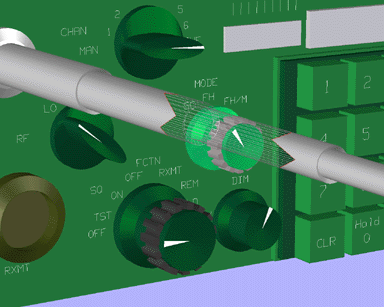
IBIS Interactive Illustration
As the user navigates, IBIS chooses different techniques to maintain the MODE dial's visibility. In this case a cutaway-mask is automatically generated.
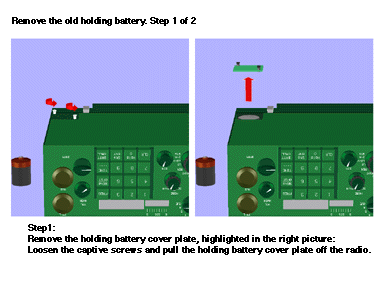


IBIS Composite Illustration in COMET.
IBIS determines two illustrations are needed to show the steps in the procedure, highlights the screws in the first and the cover plate in the second. IBIS generates different types of arrows to show the operations and selects the viewing paramaters to show enough of the radio that it is recognizable. In the automatically generated textual explanation, COMET augmented the text with the two generated cross-references (refering to the design and stylistic choices made by IBIS).
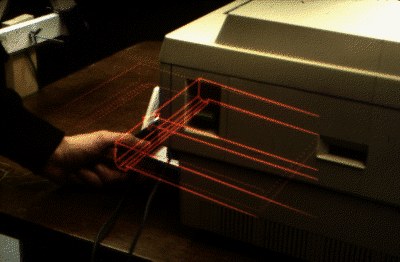


IBIS Interactive Illustration for KARMA (for a head-mounted display).
It is designed to show how to remove the printer's paper tray.
(Available slide from SIGGRAPH Techinal Slide Set '93 #25 .)
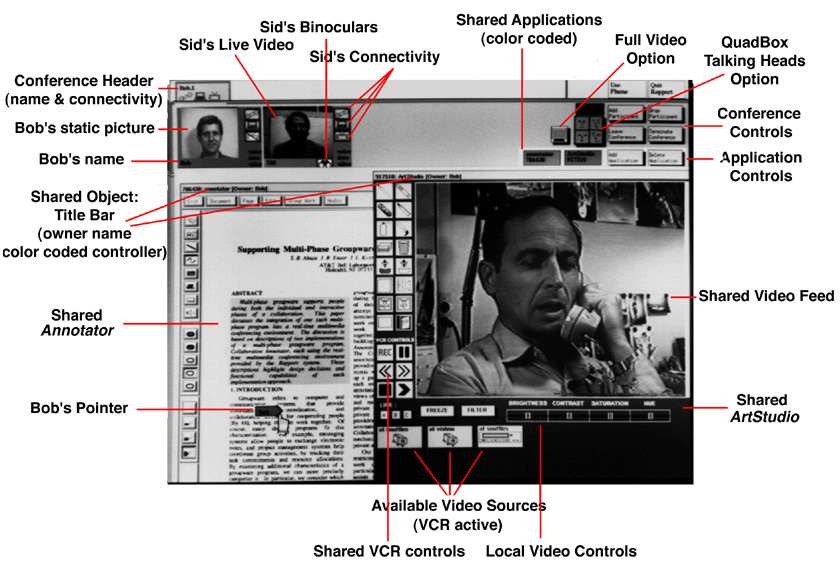


Rapport Multimedia Conferencing System.
Rapport was the first multimedia conferencing system at Bell Labs which used the model of persistent virtual meeting rooms. The Rapport interface integrated the content and interfaces to separate media services into one cohesive display. This screen shot shows Bob Ensor's view of a virtual meeting room that he is sharing with Sid Ahuja.
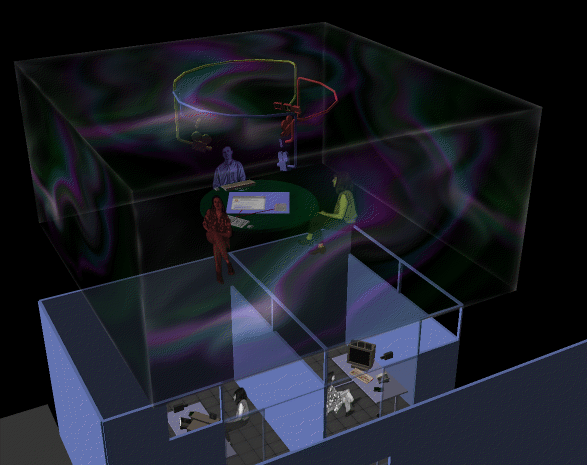


ARCHWAYS: automatically generated virtual environment for multimedia communication
John, Cati, and Dorée sharing application programs and video and voice in a virtual meeting room.